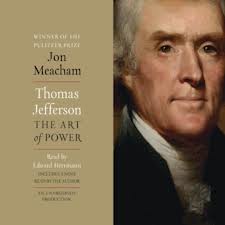
Thomas
Jefferson: The Art of Power by Jon Meacham is the second Jefferson
biography that I have read in the last few months. After reading American
Sphinx: The Character of Thomas Jefferson by Joseph Ellis I thought that
reading Meacham’s book would give me an interesting and perhaps alternate
perspective on the subject of this American icon. My commentary on Ellis’s book
as well as a basic recapitulation of Jefferson’s life is here.
Meacham’s book is extremely
balanced in terms of the various aspects of Jefferson’s life. Though Meacham’s
central theme and contention is that Jefferson was a masterful politician and
wielder of various forms of power, this work effectively covers and connects
Jefferson’s personal, professional and philosophical life. This is a very
complete and rounded account. It more evenly covers the various facets of
Jefferson’s persona than Ellis’s work. Conversely, I found Ellis’s book to
delve deeper and to provide a more comprehensive analysis of Jefferson’s
political philosophy.
Since there are so many
interesting angles of Jefferson’s life covered in this work, I cannot
comprehensively encapsulate the material entirely in a single blog post. I will
concentrate on what Meacham intended to be the main theme, though really it is
only one of several important threads. That main theme is that Jefferson was
masterful and pragmatic when he applied power, particularly political
power. This brilliant political
style led to an incredibly transformative and successful presidency.
Jefferson’s accomplishments as
America’s third President were transformative and impressive. Just to name some
of his successes, the Louisiana Purchase, a bold move in many ways, doubled the
size of the United States and avoided conflict with France. Capital improvement
projects involving roads and waterways laid the foundation for future economic
prosperity. This President also championed individual rights and expanded
participation in government to the masses (at least for white male
masses). All of this was
accomplished despite the fact that, as I highlighted in my previous commentary,
Jefferson’s political and social philosophy often veered into the radical.
During the period of George
Washington’s administration, American politics and politicians split into two
bitterly divided factions: the Republicans (no connection with today’s modern
American Republican Party, this Republican Party eventually changed its name
and is now, centuries later, the modern American Democratic Party), led by
Jefferson, versus the Federalists, led by Alexander Hamilton. The Republicans
believed in a smaller, weaker, central government. They were pro-agriculture, anti-capitalism, and wanted few
checks on the will of the people. The Federalists wanted a more activist and
powerful central government, especially when it came to the economics and
finance; they were pro-capitalism, and distrusted the general population.
Jefferson, at least before he
ascended to the Presidency, expressed support of an extreme version of the
Republican viewpoint. He wanted a government with few checks and balances upon
the will of the people. He advocated for the dismantling of America’s new
finance system created by Hamilton. He also wanted America to remain primarily
an agricultural society.
Yet, Meacham points out, as soon
as he came into power he began to govern as a pragmatic centrist,
“Critics of Jefferson have
argued that his vision of an agrarian nation with a weak central government
puts him on the wrong side of history. It was Hamilton, they say, who correctly
anticipated a future that would require a system of capital and large-scale
action to create the means of national greatness. This critique of Jefferson,
while familiar, is incomplete. Jefferson sent a reassuring signal to the
manufacturing and financial interests who had learned to fear him as a champion
of the agrarian over the commercial.”
During his first term in office,
an incredible opportunity for the United States was presented when France
offered to sell the enormous Louisiana Territory to America for a ridiculously
low price. Jefferson, being a vigorous advocate of a limited government felt
that he did not have the authority to make the deal and believed that he needed
to initiate the lengthy process of amending the Constitution to acquire the
authority. When it became apparent that France would withdraw the offer as a
result of such a delay, Jefferson “put aside” his political convictions and
just went ahead with the deal. Meacham portrays this event as the ultimate
triumph of political pragmatism.
It was not solely as a realistic
moderate that drove Jefferson’s successful tenure as chief executive. Though he
wrote scathing attacks concerning his political foes, when it came to “face to
face” communication Meacham describes him as a purveyor of “soft power”.
Jefferson was a charmer and skilled in the art of persuasion. The author
details how throughout his long political career, this Founder learned and
honed the skills needed to convince rather then compel, as well as the skills
needed to make people like him. Later as President these talents came in very
handy,
“Jefferson governed
personally. He knew no other way. He had watched Peyton Randolph lead the House
of Burgesses, sometimes in meetings in Randolph’s deep-red clapboard house at
Nicholson and North England streets in Williamsburg. From his time spent in the
Confederation Congress and presiding over the Senate for four years as vice
president, Jefferson appreciated how to handle lawmakers, for he had long been
one. Even then a president’s attentions meant the world to politicians and
ordinary people alike. For all his low-key republican symbolism, Jefferson
understood that access to the president himself could make all the difference
in statecraft— hence his dinners with lawmakers and his willingness to receive
callers. The strategy worked. In the Jefferson years Republicans were heard to
acknowledge that “the President’s dinners had silenced them” at moments when
they were inclined to vote against the administration. “
Even his fervent supporters
sometimes acknowledged that as governor of Virginia during the American
Revolution, Jefferson seemed weak and indecisive at times. Meacham argues that he learned from
these early mistakes. To the surprise of many of his critics, as President, Jefferson
showed strength, even aggression, by boldly taking extra constitutional
measures when buying Louisiana from France, warring with the Barbary States,
etc.
“In the partisan wars of the
1790s, many of his foes had misinterpreted his disposition toward individual
freedom rather than toward Hamiltonian authority as dreaminess and weakness.
They would learn— quickly and unmistakably— that they were wrong. “
Jefferson was a brilliant and
important enlightenment thinker. In terms of theory on individual liberty, his
writings, including the American Declaration of Independence, draw a roadmap to
individual rights and liberty that reverberates through the present day. He
also articulated wariness over the power of government that also resounds
through history.
Yet, as Meacham’s book argues, he
was also a strong, competent and brilliant real world leader. I would contend
that Jefferson was likely the only genius to attain the office of President of
the United States. I think that such a combination of great philosophical
theory and strong and effective leadership is rare in history.
Marcus Aurelius comes to mind.
Indeed upon his retirement from the presidency Meacham writes,
“From France, the U.S. consul at
Paris sent Jefferson a book about Marcus Aurelius. “ Along with the gift was a
note comparing Jefferson to the Roman Emperor.
There is so much more to this
book. Jefferson’s personal life is covered in rich human detail. This account
includes his liaison with Maria Cosworth as well as his relationship, which may
have been coerced, with Sally Hemings.
As exemplified by his relationship with Hemings, a slave that bore several of
Jefferson’s children, Meacham does not shy away from Jefferson’s flaws. His
record on slavery was poor, even by standards of the time. He initiated a horrendous
campaign of war and forced relocation upon several Native American Tribes. He
persecuted political enemies and engaged at what were at times vicious partisan
rancor.
This is a great book both for readers who know little or nothing about the man as well as
for those who are more familiar with his life story. The life, including the
contradictions, of this great thinker are well worth exploring. Meacham has
proven to be an intelligent, fair and enlightening guide.

