Showing posts with label Thomas Jefferson. Show all posts

Thursday, May 2, 2013

Revolutionary Characters by Gordon Wood


Revolutionary Characters: What Made the Founders Different by Gordon Wood is a book for fairly serious American Revolutionary era history buffs. If one is indeed such an aficionado, this is a thought provoking and fun read.

Wood’s book consists of a series of essays, each concerning a different major American Founder. George Washington, Benjamin Franklin, Thomas Jefferson, Alexander Hamilton, James Madison, John Adams, Thomas Paine, and Aaron Burr are all covered. For the most part, the pieces are not biographical sketches; instead they are analyses of the public personas of each of the men. Therefore, I would not recommend this book to readers who have only a cursory interest in the men or the era. Some of the essays, particularly the one that covers John Adams and his political theories, dig into fairly intricate concepts and issues of the time.

In several linking essays, Wood explains that the public image of these men was of the utmost importance both to the men themselves as well as the public at large. All of these men considered themselves enlightened gentleman of their times. The author argues that in this era, society did not look to or esteem private personalities. Thus, a “constructed” public personality, as long as it was kept consistent in public, was not considered disingenuous or undesirable; in fact, to some degree, private or inner character was disregarded as unimportant.

These men all spent their early years striving to become part of the enlightened elite. They rejected what at the time were traditional conceptions of hereditary elitism of the old aristocracy. Instead, the conception of a “gentleman” involved reaching, through one’s own devices, a level of education, morality and manors that placed a man above the masses of society.

Wood writes,

“To be a gentleman was to think and act like a gentleman, nothing more, an immensely radical belief with implications that few foresaw. It meant being reasonable, tolerant, honest, virtuous, and “candid,” an important eighteenth-century characteristic that connoted being unbiased and just as well as frank and sincere. Being a gentleman was the prerequisite to becoming a political leader. It signified being cosmopolitan, standing on elevated ground in order to have a large view of human affairs, and being free of the prejudices, parochialism, and religious enthusiasm of the vulgar and barbaric. It meant, in short, having all those characteristics that we today sum up in the idea of a liberal arts education.”

In addition to striving to attain the status of a gentleman, Wood explains that the Founders highly valued the concept of “disinterestedness”.  A virtuous leader needed to be wealthy enough that they did not need to work or even concern themselves with making money. In theory, only a person who was rich enough not to have interest in the profit motive could be trusted with the reigns of government. Not all of the Founders disliked mercantilism (some, like Thomas Jefferson, despised it) but most believed that it was inappropriate for a businessperson to be a politician.

Wood describes this concept,

“We today have lost most of this earlier meaning. Even educated people now use disinterested as a synonym for uninterested, meaning “indifferent or unconcerned.” It is almost as if we cannot quite imagine someone who is capable of rising above a pecuniary interest and being unselfish or impartial where an interest might be present.

In the eighteenth-century Anglo-American world gentlemen believed that only independent individuals, free of interested ties and paid by no masters, could practice such virtue. It was thought that those who had occupations and had to work strenuously for a living lacked the leisure for virtuous public leadership.”


Within this framework of a disinterested gentleman, all of the Founders, either through their own machinations or through external impositions, had constructed public personas. These characters, how they came to be, what they represented, how they affected history, etc. are generally the subjects of Wood’s essays. Each piece digs fairly deep into the analysis of Wood’s subject. Having read fairly extensively on these men and the era previously, I feel that Wood’s essays provided depth as well as both familiar and unique perspectives, though I do not agree with all of Wood’s conclusions.

One of many interesting points here was that there were always exceptions to the rules. Wood argues that Paine’s public persona did not fit that of a gentleman and Burr’s persona did not appear to be “disinterested.”

As one final irony pointed out by Wood, the nation and society that these men helped to create, that of powerful mercantile interests, an economy propelled by the acquisition of material goods and common people (though only white males) participating in political and social discussion and debate, had little interest in electing disinterested gentleman as political leaders. Thus, Wood convincingly argues that all subsequent generations of American political leaders were of a very different breed from that of the Founders.

Though not an introduction to the American Founders, this work provides important and, at least for me, intriguing information on the personalities, philosophies, perceptions and accomplishments of these very important people. There are a lot of detailed and interesting musings within the essays that I cannot come close to delving into within a single blog post. Highly recommended for those interested in the period as well as in the history of government.

The Following Posts cover related subjects:

Alexander Hamilton by Ron Chernow

American Sphinx: The Character of Thomas Jefferson by Joseph Ellis


Benjamin Franklin: An American Life by Walter Isaacson


Fallen Founder: The Life of Aaron Burr by Nancy Isenberg

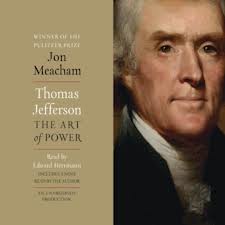
Thomas Jefferson:The Art of Power by John Meacham

Radicalism and the American Revolution by Gordon Wood


Reading Gordon Wood


Sunday, March 17, 2013

Thomas Jefferson:The Art of Power by John Meacham


Thomas Jefferson: The Art of Power by Jon Meacham is the second Jefferson biography that I have read in the last few months. After reading American Sphinx: The Character of Thomas Jefferson by Joseph Ellis I thought that reading Meacham’s book would give me an interesting and perhaps alternate perspective on the subject of this American icon. My commentary on Ellis’s book as well as a basic recapitulation of Jefferson’s life is here.


Meacham’s book is extremely balanced in terms of the various aspects of Jefferson’s life. Though Meacham’s central theme and contention is that Jefferson was a masterful politician and wielder of various forms of power, this work effectively covers and connects Jefferson’s personal, professional and philosophical life. This is a very complete and rounded account. It more evenly covers the various facets of Jefferson’s persona than Ellis’s work. Conversely, I found Ellis’s book to delve deeper and to provide a more comprehensive analysis of Jefferson’s political philosophy.

Since there are so many interesting angles of Jefferson’s life covered in this work, I cannot comprehensively encapsulate the material entirely in a single blog post. I will concentrate on what Meacham intended to be the main theme, though really it is only one of several important threads. That main theme is that Jefferson was masterful and pragmatic when he applied power, particularly political power.  This brilliant political style led to an incredibly transformative and successful presidency.

Jefferson’s accomplishments as America’s third President were transformative and impressive. Just to name some of his successes, the Louisiana Purchase, a bold move in many ways, doubled the size of the United States and avoided conflict with France. Capital improvement projects involving roads and waterways laid the foundation for future economic prosperity. This President also championed individual rights and expanded participation in government to the masses (at least for white male masses).  All of this was accomplished despite the fact that, as I highlighted in my previous commentary, Jefferson’s political and social philosophy often veered into the radical.

During the period of George Washington’s administration, American politics and politicians split into two bitterly divided factions: the Republicans (no connection with today’s modern American Republican Party, this Republican Party eventually changed its name and is now, centuries later, the modern American Democratic Party), led by Jefferson, versus the Federalists, led by Alexander Hamilton. The Republicans believed in a smaller, weaker, central government.  They were pro-agriculture, anti-capitalism, and wanted few checks on the will of the people. The Federalists wanted a more activist and powerful central government, especially when it came to the economics and finance; they were pro-capitalism, and distrusted the general population.

Jefferson, at least before he ascended to the Presidency, expressed support of an extreme version of the Republican viewpoint. He wanted a government with few checks and balances upon the will of the people. He advocated for the dismantling of America’s new finance system created by Hamilton. He also wanted America to remain primarily an agricultural society.

Yet, Meacham points out, as soon as he came into power he began to govern as a pragmatic centrist,

“Critics of Jefferson have argued that his vision of an agrarian nation with a weak central government puts him on the wrong side of history. It was Hamilton, they say, who correctly anticipated a future that would require a system of capital and large-scale action to create the means of national greatness. This critique of Jefferson, while familiar, is incomplete. Jefferson sent a reassuring signal to the manufacturing and financial interests who had learned to fear him as a champion of the agrarian over the commercial.”

During his first term in office, an incredible opportunity for the United States was presented when France offered to sell the enormous Louisiana Territory to America for a ridiculously low price. Jefferson, being a vigorous advocate of a limited government felt that he did not have the authority to make the deal and believed that he needed to initiate the lengthy process of amending the Constitution to acquire the authority. When it became apparent that France would withdraw the offer as a result of such a delay, Jefferson “put aside” his political convictions and just went ahead with the deal. Meacham portrays this event as the ultimate triumph of political pragmatism.

It was not solely as a realistic moderate that drove Jefferson’s successful tenure as chief executive. Though he wrote scathing attacks concerning his political foes, when it came to “face to face” communication Meacham describes him as a purveyor of “soft power”. Jefferson was a charmer and skilled in the art of persuasion. The author details how throughout his long political career, this Founder learned and honed the skills needed to convince rather then compel, as well as the skills needed to make people like him. Later as President these talents came in very handy,

Jefferson governed personally. He knew no other way. He had watched Peyton Randolph lead the House of Burgesses, sometimes in meetings in Randolph’s deep-red clapboard house at Nicholson and North England streets in Williamsburg. From his time spent in the Confederation Congress and presiding over the Senate for four years as vice president, Jefferson appreciated how to handle lawmakers, for he had long been one. Even then a president’s attentions meant the world to politicians and ordinary people alike. For all his low-key republican symbolism, Jefferson understood that access to the president himself could make all the difference in statecraft— hence his dinners with lawmakers and his willingness to receive callers. The strategy worked. In the Jefferson years Republicans were heard to acknowledge that “the President’s dinners had silenced them” at moments when they were inclined to vote against the administration. “

Even his fervent supporters sometimes acknowledged that as governor of Virginia during the American Revolution, Jefferson seemed weak and indecisive at times.  Meacham argues that he learned from these early mistakes. To the surprise of many of his critics, as President, Jefferson showed strength, even aggression, by boldly taking extra constitutional measures when buying Louisiana from France, warring with the Barbary States, etc.

In the partisan wars of the 1790s, many of his foes had misinterpreted his disposition toward individual freedom rather than toward Hamiltonian authority as dreaminess and weakness. They would learn— quickly and unmistakably— that they were wrong. “

 Jefferson was a brilliant and important enlightenment thinker. In terms of theory on individual liberty, his writings, including the American Declaration of Independence, draw a roadmap to individual rights and liberty that reverberates through the present day. He also articulated wariness over the power of government that also resounds through history.

Yet, as Meacham’s book argues, he was also a strong, competent and brilliant real world leader. I would contend that Jefferson was likely the only genius to attain the office of President of the United States. I think that such a combination of great philosophical theory and strong and effective leadership is rare in history.

Marcus Aurelius comes to mind. Indeed upon his retirement from the presidency Meacham writes,

“From France, the U.S. consul at Paris sent Jefferson a book about Marcus Aurelius. “ Along with the gift was a note comparing Jefferson to the Roman Emperor.

 There is so much more to this book. Jefferson’s personal life is covered in rich human detail. This account includes his liaison with Maria Cosworth as well as his relationship, which may have been coerced, with Sally Hemings. As exemplified by his relationship with Hemings, a slave that bore several of Jefferson’s children, Meacham does not shy away from Jefferson’s flaws. His record on slavery was poor, even by standards of the time. He initiated a horrendous campaign of war and forced relocation upon several Native American Tribes. He persecuted political enemies and engaged at what were at times vicious partisan rancor.

This is a great book both for readers who know little or nothing about the man as well as for those who are more familiar with his life story. The life, including the contradictions, of this great thinker are well worth exploring. Meacham has proven to be an intelligent, fair and enlightening guide.

Sunday, February 3, 2013

American Sphinx: The Character of Thomas Jefferson by Joseph Ellis


American Sphinx: The Character of Thomas Jefferson by Joseph J. Ellis is an exploration of Thomas Jefferson’s life, career and ideas that, while it strives for balance, is highly critical of the American icon. One of the main points of this work is that this founding father was man of both enormous complexity as well as contradictions.

Born in 1743, Jefferson was member of Virginia’s elite planter class. He was a wealthy man whose livelihood was deeply connected to the ownership of slaves. An early critic of British control over the colonies, Jefferson distinguished himself as a brilliant writer and rhetorician. 

While serving in the Second Continental Congress, Jefferson penned his most famous prose as the primary author of the Declaration of Independence. Later, he served as governor of Virginia, Minister to France and America’s First Secretary of State, as well its second Vice President.

Chosen as America’s third President in 1800, Jefferson endeavored to shrink the size of the American government during his terms in office, waged war upon the Barbary States, and attempted to keep the United States neutral in the conflict between Britain and France. His most notable achievement was in securing the Louisiana Purchase, which doubled the size of the United States. 

After retirement from the Presidency, Jefferson began an amazing political-philosophical correspondence with John Adams. The two were lifelong friends who had been estranged for several years due to political battles. Their association rekindled as the pair aged. The two carried on the exchange of letters until their respective deaths. The documentation created by this line of communication has been studied by historians and students of government ever since. Ironically, the two died on the same day, July 4th, 1826, the fiftieth anniversary of the signing of the Declaration of Independence.

It is difficult for me to comment upon this book in a vacuum. America’s Revolutionary generation has been a lifetime interest of mine. I have read somewhat extensively on Jefferson and his peers. Thus, I come into this work with a fair amount of knowledge as well as a lot of opinions.

Ellis effectively weaves the events of Jefferson’s life with an insightful analysis of the man’s character, psychology and philosophy. In terms of his virtues and sins, as well as his actions and ideas, Jefferson was a man of paradoxes and riddles, hence the “Sphinx” of the title. For instance, while Jefferson’s rhetoric about individual freedom often soared, he had one of the worst records in regards to slave ownership when compared to the other founders.

Based upon this book as well as many additional sources and readings that I have encountered over the years, I am struck by how monumental Jefferson’s achievements and thoughts were in contrast to his extraordinary flaws and just plain bad ideas that he espoused. An important point concerning these character weaknesses is that they are not only highlighted by contemporary critics looking back and judging Jefferson by modern standards, rather, they were initially recognized by his peers. 

Are some people more complex than others? Ellis makes a convincing case that Jefferson’s acts and beliefs were so multifarious that this founder presents an historical enigma that transcends other famous personages. Thus, when it comes to this book, as well as Jefferson himself, there are too many aspects to Jefferson’s achievements, character and philosophy for me to adequately summarize within a single blog post. I would need to write a series of entries in order to do so.

I will therefore focus upon only one of many striking aspects of the Jeffersonian persona that are illustrated in this book. While America’s third President was a titanic political philosopher and thinker, he was also a radical, both by the standards of our time as well as those of his own. In my opinion this sets Jefferson apart from America’s other major founders, who I would describe as being moderate or even conservative in terms of the change that they were attempting to propel. In consequence, today’s extreme partisans on both America’s political right and left wings have embraced many of Jefferson’s ideals.

In what way was he so radical? Unlike George Washington, John Adams, Alexander Hamilton, James Madison, etc., Jefferson had no distrust of the mass of common people and had no use for a balanced government. Significantly, he was not even in the United States when the Constitution was drafted (he was Minister to France at the time) and played almost no role in its construction. On multiple occasions, Jefferson espoused his belief in a government comprised of a single one-house legislature elected directly by the people. He believed in a weak Presidency and no Federal Court system. He argued that such institutions could only thwart the people’s will. His belief in the infallibility of the common people (who Jefferson only counted as white men, but, notably for the time, all white men, not just landowners) led him to oppose any “checks or balances” in the power of the people’s legislature. 

Jefferson was not an unabashed advocate of the American Constitution and believed that it was an actual impediment to true republicanism. Ellis writes,

Jefferson tended to view it as a merely convenient agreement about political institutions that ought not to bind future generations or prevent the seminal source of all political power—popular opinion—from dictating government policy. “


Furthermore, Jefferson was an advocate of a citizenry’s right to overturn or secede from an unpopular government through extralegal and, at times, violent means. In one of his most famous quotations Jefferson stated, 

“The tree of liberty must be refreshed from time to time with the blood of patriots and tyrants. It is it's natural manure.”

Lest anyone believe that Jefferson sounds like a modern day laissez-faire conservative, he also alleged that mercantilism, industrialism and banking were a mortal threat to the nation’s well being. Instead he championed a society dominated by agricultural interests.

Ellis describes his views,

“[Jefferson believed that] America should remain a predominantly agricultural economy and society. Domestic manufacturing was permissible, but large factories should be resisted. Most important, the English model of a thoroughly commercial and industrial society in which the economy was dominated by merchants, bankers and industrialists should be avoided at all costs. “We may exclude them from our territory,” he warned, “as we do persons afflicted with disease,” going so far as to recommend that if one region of the United States should ever become thoroughly commercialized, the remaining agrarian region should secede”.

As Ellis points out, Jefferson lived in a different era. However, in Jefferson’s time these views were not mainstream nor were they shared by Jefferson’s peers.  Hamilton and, to a lesser degree, Washington, Adams and others were frequently appalled and dismayed by Jefferson’s philosophy. 

Other aspects of Jefferson’s views, radical at the time, became the basis for much of what modern society considers individual freedom and rights. 

 Ellis writes,

Alone among the influential political thinkers of the revolutionary generation, Jefferson began with the assumption of individual sovereignty, then attempted to develop prescriptions for government that at best protected individual rights and at worst minimized the impact of government “

Jefferson ultimately was a believer in a republican utopianism. He espoused an agricultural based society with very little government or large institutions. He argued that in such a free society people would take care of themselves. It goes without saying that neither the United States nor any other state evolved in the way that Jefferson would have preferred. It seems clear to me that the state and society that Jefferson espoused would lead to a nation fraught with chaos and instability. Human progress would have been impossible under such a system.

Interestingly, when Jefferson ascended to the Presidency, he took a much more pragmatic and, at times, hypocritical approach than his beliefs would lead one to expect. For instance, he exceeded his executive power when he purchased Louisiana; he also did not dismantle the American banking and finance system that he professed to despise. Unfortunately, in actions that can be characterized as oppressive, he initiated prosecutions against his political and ideological enemies.

Ellis’s book is about so much more than the above commentary concerning Jefferson’s political and social values. This founder’s virtues and accomplishments were indeed immense. Unfortunately, his hypocrisies were also legendary. His views on religion, history and science as well as his personal life also interwove together and had a profound effect on American culture and politics, as well as upon world civilization. Ellis effectively explores all of this and more.

There are many, many reasons to study Jefferson. He is a figure of immense historical importance and one of the most complex people who ever lived. In American Sphinx: The Character of Thomas Jefferson Ellis has created a highly readable and coherent account of this thinker’s accomplishments, beliefs and failings.


A few years ago I read His Excellency: George Washington which is another of Ellis’s books. I highly recommend that work too.