Pages

Showing posts with label American Revolution. Show all posts

Sunday, November 3, 2019

Women of the Republic by Linda Kerber

Women of the Republic by Linda Kerber is an examination of the legal and social changes that a certain group of women experienced in The American Revolutionary era. I read this book because I had heard that, along with Revolutionary Mothers by Carol Berkin, this was the best source on women’s roles during The American Revolution. My commentary on Berkin’s book is here. Folks who are familiar with my blog know that The American Revolutionary era is a lifelong interest of mine. This work was first published in 1980. I found that this book was very different from Berkin’s work. I thought that it was less engaging but well researched and informative. 

I noted above that this book only covered a certain group of women because, unlike Revolutionary Mothers, Kerber only covers white women living in Continental, and later independent America. There is nothing here about black, or Native American women.

Kerber first covers the role that these women played in colonial and early American society as well as during the Revolution. Women, before the Revolution, were considered apolitical and were expected to follow their husbands’ lead but stay out of all public debates and discussions. Starting in the years before the Revolution, this began to change. Women began to participate in anti - British boycotts and took part on campaigns to produce goods in America instead of importing them from England. Once the war started some women began to be more  involved in politics. Women also took over the management of property, farms and businesses when their husbands went off to war. 

According to Kerber, before the Revolution, if women engaged in political conversation it was frowned upon. The author details how even political themed letters between Abigail Adams and Mercy Otis Warren were derided and caused a bit of a scandal.

Kerber spends some pages exploring Coverture Laws. These laws viewed married couples as one person. Though interpreted differently in different colonies and states, these laws basically had the effect taking any property that a woman brought into marriage and, with some limitations, gave control of it to the husband. If the wife outlived the husband, control of the property was supposed to revert back to her. Other laws only allowed a wife to inherit about one third of a husband’s property, or what today would be considered joint property, after his death.

Kerber goes into great detail explaining these laws and exploring multiple legal cases that led to their evolution during The Revolutionary Era. She concludes that the situation become less advantageous for women during this period. Though I usually find interest in most things I read, I must admit to finding this part of the book a bit tedious. 

Kerber also explores divorce during this era. As local governments were mostly in the hands of the rebels, local politicians wanted to encourage women who sympathized with the rebellion to divorce their loyalist husbands.  This helped to loosen up divorce laws and customs in some places. 

An important concept that is explored is the idea of The Republican Mother. During the years of the Revolution and afterwards, the idea developed that women can have political opinions and that they should be educated. This was so that they could raise good sons and keep their husbands’ worst impulses in check. Though this represented some progress for women, this idea also perpetuated the concept that men’s and women’s spheres were different and that women’s roles was still restricted to the home. Kerber makes honest arguments, while she points out this lack of progress she also speculates that deeper social change might have actually opened the door to the negative outcomes that occurred during the French Revolution. She writes,

Women could be encouraged to contain their judgements as republicans within their homes and families rather than to bridge the world outside and the world within. In this sense, restricting women’s politicization was one of a series of conservative choices that Americans made in the postwar years as they avoided the full implications of their own revolutionary radicalism. In America, responsibility for maintaining public virtue was channeled into domestic life. By these decisions Americans may well have been spared the agony of the French cycle of more blood and produced a political system more retrogressive than had the American war. Nevertheless, the impact of many of these choices was to inhibit the resolution of matters of particular concern for women. 

Another interesting concept was the debate as to what women should actually learn. There was a particular concern that reading fiction was bad for both sexes but particularly bad for women. Some beloved that fiction, even when it had a moral behind it, led to sloth and debauchery. Many advocated that women should instead read history. Kerber explored various angles to this debate. 

This book is somewhat scholarly and is detailed and theory driven. I would say that those who are very interested in the evolution of women’s rights in both social and legal spheres during this era would be interested in this. The book is nothing like Berkin’s work, which explored very diverse groups of women as well as individual women. 

This book has a fairly narrow range. It digs into a lot of detail within that range. At times, even for a reader who is interested in these subjects, it might get a little dull. Thus, Revolutionary Mothers will be better choice for many readers. With that, this book is educational and sheds a lot of light on the subjects that it covers. It also seems to be well researched. I recommend this to this who are very interested and who wish to go deep into to these subjects. 

Saturday, August 17, 2019

Revolutionary Mothers by Carol Berkin

Revolutionary Mothers by Carol Berkin is a survey of women’s role in the American Revolution. The author does a good job of chronicling this underreported aspect of the conflict. As folks who have read my blog in the past know, The American Revolutionary period is of particular interest to me. This work helped to fill in a lot of gaps and enhanced my understanding of The Revolution itself.  I wanted to read a book that centered on women and the Revolution and I had heard that this work, along with Women of the Republic by Linda K. Kerber, were the most respected on the subject. I may read Kerber’s book soon. 

Berkin covers multiple categories of women in this book. One thing that makes it difficult to write about this work is its survey nature.  It covers a lot of fairly unconnected topics concerning women who came from very different backgrounds and cultures. Segments are dedicated to women on the patriot side, loyalist women, black women, Native American women, camp followers, and women who engaged in espionage as well as actual combat. A lot of issues and trends are explored. A few main points involve: patriot women taking on male roles of household and farm management when their husbands went off to the war; persecution of loyalist women and their eventual displacement from their homes; women in actual combat; Native American women who sometimes held leadership roles in their societies; black women who were usually enslaved , many of whom took the opportunity to attempt to flee to the British side as British commanders had promised them freedom. The author tells of many personal accounts and relies heavily on diary entries and letters. 

The book concludes with an examination of the aftermath of the Revolution in regard to women. As a result of the revolutionary spirit and the fact that so many women took on important roles, many Americans, both men and women, argued for equality. The result was a major change in women’s education in America. In most places, girls were provided the same education as boys. Unfortunately, reform stopped there. Berkin explores the reasons for this. 

As I mentioned above, because this book brings up so many points and focuses on so many individual women, it is difficult to pin much down in a single blog post. For instance, there is a lot here about camp followers. Both American and British armies had a groups of thousands of women who followed them around. These consisted of a combination of women that provided laundry and other services, wives of enlisted men, and prostitutes. I had previously known a little bit about camp followers, but this work really dug into the details concerning the many different women who composed this group. Camp followers are just one among several groups that are focused on on in this book. 

Just one fascinating example of the many individuals covered in this work is Molly Brant. Most of the tribes of the Iroquois nation chose to side with the British. Thus, there was heavy and brutal fighting between American and Native American forces in upper New York State. The more I read about the Native Americans in the era when they came into contact with whites, the more I realize that there were a lot of people who fit into and moved between both white and Native American worlds. Brant was such a person. She was a Mohawk from a powerful family.  The Mohawks were one of several Iroquois tribes. Women held more power in Iroquois society as opposed to European and Colonial society. In this area, the Iroquois and some other tribes were more enlightened than the Europeans. Brant in particular held a position of power and influence within the Iroquois confederation.  She also married Sir William Johnson, who was a high British official involved in Native American affairs. Brant was supposedly very comfortable and mixed freely in booth Iroquois and European society.  As an important member of Iroquois leadership, Brant helped guide the tribe into an alliance with The British. Throughout the war, she served as a liaison and supporter of The British cause. Berkin writes,
                                                                                                                    
Throughout the war, the British relied heavily on Molly’s influence with the Mohawks. It was Molly who persuaded the Society of Six Nations Matrons to press their men to fight for the king, and it was Molly who rallied these Indian warriors when they began to question their participation in the war . British officials never underestimated her importance.

This work is filled with similar interesting and important stories. 

This is very good book. Though it is not that long, it covers a lot of ground and shines light into lots of areas. It is full of interesting accounts, and I learned a lot from it.  Berkin is also a very good writer who manages to hold my interest throughout. I recommend this to anyone interested in the American revolutionary era, women’s’ history, or the social history of America.


Friday, September 28, 2018

Independence Lost by Kathleen DuVal

Independence Lost: Lives on the Edge of the American Revolution by Kathleen DuVal was first published in 2016. The author is a professor of early American history at the University of North Carolina. The subject of this work is Spain’s war with Great Britain in the Gulf of Mexico. This conflict was part of the American Revolution. Over the last couple of years, this book has gotten a lot of buzz among those who read and talk a lot about the American Revolution. DuVal has taken what is, on the surface a military history, and turned it into a study of people, culture and long term historical impact. In the end, she draws an unusual combination of conclusions. 

A little background on the situation in the Gulf of Mexico during the American Revolution helps one to understand what this book is about. The thirteen rebellious colonies that formed the young United States were not the only European colonies in the region. Over the course of decades, European colonies in the Gulf of Mexico had been traded with some frequency, as a result of war and diplomacy, between Great Britain, France and Spain.  At the time of the American War for Independence, Louisiana and Cuba were Spanish colonies. East Florida and West Florida were British colonies that did not join the rebellion against Great Britain. 

This book is about the Spanish invasion, launched from Louisiana and Cuba, into British West Florida and its aftermath. Adding to the complexity of the situation was the fact that the British had native American allies that played a major part in the conflict. The book also covers the years after the war. Peace saw the emergence of the new United States as well as a resurgent Spain, which controlled large parts of North America, including Florida and New Orleans. Spain attempted to set up a system of alliances with Native American tribes in an attempt to prevent the United States from further expansion. DuVal argues that this strategy actually worked until instability in Napoleonic Europe weakened the Spanish Empire. 

Though the subjects involve military and political events, this book is very much a social history. Duval focuses on individuals. Many residents of the region are put under the microscope. These include natives and immigrants from Great Britain, France and Spain, the first Cajuns who settled around New Orleans, slaves and Native Americans.  The region was a hodgepodge of these groups. Individuals and families needed to choose which side to take and how they would participate in the conflict. 

The lives of some fascinating people are explored. For instance, Amand Broussard was a settler living in Louisiana. He was an Acadian of French ancestry whose parents had been exiled from Canada and treated harshly by the British in what was known as the Great Expulsion. He and his fellow exiles thirsted for revenge against Great Britain and enthusiastically volunteered for military service with the Spanish to fight against the British. The descendants of Broussard’s people are today called Cajuns. 

Another person highlighted was Alexander McGillivray. His father was a slave-holding plantation owner in Georgia. His mother was a Creek woman from a prominent family. McGillivray grew up in both Native American and Colonial American worlds. When the American Revolution broke out, his father chose to stay loyal to Great Britain. McGillivray went on to lead the Creeks in support of Great Britain against the Spanish and later allied himself and his people with Spain against a young United States. 

Many other men and women are the subject of the narrative. DuVal points out that records and sources on women are sparse but she tries to paint a picture of some individuals. 

The author tends to focus on motivations. She argues that few people in the region were concerned with theoretical concepts of liberty and were generally not debating independence. Instead, relationships and interdependence were valued by many. She writes,

“For most, advantageous interdependence was a more logical goal. Leaders of all kinds of polities struggled to establish a balance in which they might have more control over dependent relationships. Sovereign states involved networks of dependency. Families and individuals measured their freedom according to how much less dependent they were on others than others were on them.”

Lately, I have read several books on Spain’s role in the American Revolution, including Brothers at Armsby Larrie D. Ferreiro. My commentary on that work is here. I have also read Gibraltar, The Greatest Siege in British History by Roy Adkins and Lesly Adkins. My commentary on that work is HERE.  These books have filled in a lot of gaps for me. For instance, over the years I have encountered many sources that acknowledged that Great Britain was very generous towards the new United States in ceding large tracts of land east of the Mississippi River after the Revolution. I always wondered why that was the case. In this book, DuVal contends that the British did so to keep the territory from being taken over by the Spanish. The British were more concerned with Spain’s empire than they were with the new United States. 

DuVal tries to make several points in this book and takes some surprising twists in her conclusions. She successfully shows the American Revolution and its effects from the point of view of groups that had in the past been neglected. That is, slaves, Native Americans and women. In recent years, many authors who write about the Revolution have begun to highlight these groups, as they have been neglected in the past.  In this spirit, this work is a very effective and interesting examination of a whole host of diverse people and groups.  

Next, DuVal tries to show that the foundation of the United States was, in the short to medium-term, harmful to women, slaves and native Americans.  She points out that the Revolution really meant liberty for white men. However, she does acknowledge that the ideals embodied and codified in the American Revolution eventually contributed to the concepts of equality and freedom for a diverse group of people. Ultimately, however, this book is highly critical of Revolutionary America and the early United States for excluding the majority of people from its concept of liberty. 

Whenever issues such as this are touched, we enter the territory of the cultural debates, or what some call culture wars, that are going on today. Up to this point, DuVal takes a course that is characteristic of a certain ideology that is popular in quarters on the left. That is, she highlights groups that in the past were unrepresented, and is negative about the young United States for being dominated by white men. However, DuVal next takes a very unusual turn. The author goes on to contend that women, nonwhites, slaves, Native Americans and other groups were better off under the imperial colonial powers of Great Britain, France, and Spain than they were under Republican America. Championing colonial powers is anathema to the historical criticism that I referred to above. Thus, I was surprised that the author made this argument. 

DuVal points out that Republican America bestowed most of its benefits on white men. It went on to virtually destroy numerous native American societies.  Furthermore, she argues that while all these societies - the United States, the Colonial Empires and Native Americans - had slaves, that the slavery in the United States was particularly brutal and did not allow slaves to buy or earn their freedom as the other systems did. She also argues that women had more rights under the colonial systems. Furthermore, the author maintains that the empires had developed an interdependent system of commerce and alliances with Native American groups that would not have involved the overrunning of these groups as the United States eventually did. 

This is an unusual mix of contentions. Duval initially takes what is a left leaning position and mixes it with what seems to be a take that is pro-colonialism. Whether one agrees or disagrees with the author, it cannot be said that she is afraid to go out of the box and take on controversial positions that do not all fall within a particular ideology. I should also note that Duval’s controversial conclusions only comprise the concluding pages of the book. The majority of the work is more or less straight history. This is not uncommon with a lot of history books. 

My take on all of this is as follows: the American Revolution was indeed centered on white men and involved a lot of hypocrisy. It goes without saying that slavery was a source of terrible injustice and misery and represented a terrible hypocrisy at the heart of the American Revolution. Many of the founders, such as Alexander Hamilton, recognized this themselves. The expansion of America was also a cataclysm for Native Americans. It is important that historians like DuVal point these wrongs out and examine these issues. For all this, the American Revolution was a vital advancement in human progress. It laid the groundwork for so much progress and liberty that eventually provided enormous benefits to many groups. DuVal does point this out. In  my opinion, while not completely dismissing them,  she does not give enough credit to these positive aspects of the Revolution. 

I also think Colonialism was morally wrong. However, as much as imperial systems were oppressive, DuVal makes a persuasive point, that the systems that the empires set up in North America, similar to the systems that were set up in India and Africa, did not involve Europeans overrunning the entire continent and this wiping out entire cultures. Thus, Native Americans of North America would likely have fared better under these colonial systems. This is a point that Fred Anderson also made in The Crucible of War.

Finally, DuVal does seem to minimize some of the terrible things that both the empires and the Native American tribes did. She downplays their systems of slavery. She ignores many violent and repressive things that the empires, especially the Spanish Empire, engaged in. This may be the biggest flaw in DuVal’s argument. 

Though its subject is fairly narrow, this is a terrific history book. The way that it focuses on individuals as well as social history, while not ignoring the political and military, makes this work a very compelling read. Whether one agrees with Duval or not, she is not afraid to challenge convention.  At the very least, she encourages her readers to think. I highly recommend this to anyone interested in the American Revolution, as well as seventeenth-century history in general. 


Monday, August 27, 2018

Gibraltar, The Greatest Siege in British History by Roy Adkins and Lesly Adkins

Gibraltar, The Greatest Siege in British History by Roy Adkins and Lesly Adkins was first published this year. The subject is the Spanish and French siege of British controlled Gibraltar that occurred between 1779 and 1783. This book is a military, social and political history. Though I think that the title is a little sensationalist, this is well written and researched. It tells a fascinating story. The writers are a husband and wife team. They are both historians and archeologists. 

Such a large event involving all sorts of history that occurred in Europe during this time period is in and of itself of interest to me. However, I also wanted to know more about this siege because it was part of the world - wide conflict between Great Britain, France and Spain that The American Revolution was also part of. In fact, many sources classify this siege as being part of The American Revolution. The authors of this book even write, 

"Although the Great Siege has no other name, it was in reality part of the American War of Independence. The actions and ambitions of France and Spain had caused that war to spill across the Atlantic into Europe, and the war zone would extend from Britain to Gibraltar, Spain and Minorca."

The conflict actually spanned the entire world. Personally, I think that this war needs another name. It encompassed both The American Revolution and what was known as The Second Anglo-Mysore War in India. It does not have one however. 

It turns out that, to a great extent, Spain, joined France and the rebellious American Colonies in a war against Great Britain because it wanted to take Gibraltar from The British.  One theme that I came across in  this work as well as in Brothers at Armsby Larrie D. Ferreiro was that in a way, Great Britain sacrificed America for Gibraltar. In diplomatic wranglings before Spain went to war with Great Britain, it demanded that Great Britain cede the fortress as it had been Spanish territory in the past.  Had Great Britain acquiesced, Spain would have stayed out of the war. This world have increased the chance of a British victory that would have led it to retain America. 

Later, as this work illustrates, enormous resources were diverted to hold Gibraltar. These resources would have made a great difference in America. In fact, a fleet that Great Britain sent to relieve Gibraltar was diverted from intercepting a French Fleet that played a decisive part in Great Britain’s loss at Yorktown. That defeat cemented the American victory against Great Britain.

The authors cite multiple sources to illustrate this point. They write, 

“In 1783 the Scottish politician and prolific writer Sir John Sinclair anonymously published a booklet in which he expressed the opinion that Spain had only supported America’s bid for independence in the expectation of gaining Gibraltar: ‘the possession of America has been sacrificed to the retention of Gibraltar. That darling object could alone have induced Spain to countenance the independence of our Colonies, and without her assistance that event could never have taken place.’ “

Once Spain declared war, both the British garrison as well as civilian population were besieged on Gibraltar. The Spanish cut off land access and tried to enforce a sea blockade. Initially the Spanish just tried to cut off supplies. Though some ships with food and provisions got through, there was hunger and depravation amongst the besieged. While there were no actual famine deaths some did die of scurvy and other diseases.  Thrice, large convoys made it through the blockade providing months of food and supplies. 
  
Later, an artillery bombardment, that lasted for years began.  This caused great hardship for soldiers and civilians alike. Several large sea battles took place as well as fighting on land as the Spanish tried to dig trenches and build fortifications closer and closer to the Gibraltar garrison. 

Toward the end of the siege, The Spanish, along with newly arrived French forces, went all out. Ten huge ‘Floating Batteries” were constructed. These were old merchant ships that were highly modified. One side was of each vessel was heavily reinforced with layers of protection. These ships were also filled with cannons. The goal of these unwieldy and lopsided  vessels was to serve as indestructible gun platforms that would destroy Gibraltar’s considerable defenses and artillery emplacements. An army of 50,000 was also assembled for a final assault on the fortress. Over the course of a single day and night, Gibraltar’s formidable artillery, using red hot cannonballs, designed to set these ships on fire, engaged in a massive firefight with these vessels. I have read a fair amount of military history, but I never before read about a battle like this one.

The book celebrates heroism and courage but does not glorify war. The authors’ pull no punches at the horrors that occurred. The deprivation and disease that both the garrison and the besiegers is detailed. Deaths caused by battle are also described realistically. When the Spanish and French launched their large - scale assault on the garrison, people on both sides died. But the Spanish sailors suffered terribly. Thousands perished in the infernos that the floating batteries became as the searing - hot English cannon balls took their toll. 

This book consists of extremely long quotations from the diaries and journals of those who participated. In fact, I do not think that I have read a history book before with so much first - hand material. I would estimate that these quotations make up approximately twenty five percent of the book. Though I found this a bit excessive, I also found that this gave a sense of authenticacy to the work. 

One negative about this book is that it is almost entirely told from the British point of view. Spanish and French strategy as well as what that side experienced is presented almost as an afterthought. It seems that the authors’ intentionally set out to tell this history in this fashion. However, I think that this would have been a much stronger account had it been balanced. 

This is an extremely well researched history book. It tells, what for me, is an intriguing story. It describes an important and unique event in history. However, it contains a lot of it is military history and descriptions of battles. Thus, those not interested in such might not care for this work.  If that is not an issue for the reader, this is a book that will appeal strongly to those interested in this period of European and American history. 

Saturday, July 14, 2018

Brothers at Arms by Larrie D. Ferreiro

Brothers at Arms by Larrie D. Ferreiro was first published in 2016. It is a chronicle of French and Spanish involvement in the American Revolution. I found the book to be well written, informative as well as very interesting. 


Both France and Spain provided a great deal of aid to the American rebels during the revolution. Later, both declared war on Great Britain. Land and sea battles, some of them fairly large, were fought throughout the world between these world powers. This work is primarily a political, social and military history. 

I would only recommend this book to those who already have at least a basic understanding of the American Revolution. The subject matter here is a little esoteric.  However, I think for those who do have such knowledge and are interested in the subject will get a lot out of this book. 

For me, as someone who has read about the revolutionary period throughout my life, the book covered a combination of material that I have some familiarity with as well as material that was new to me. Early American diplomatic efforts aimed at France are covered. The massive aid that France provided to the United States is detailed. 

France and Spain eventually declared war on Great Britain. Later, The Dutch Republic and the Indian Kingdom of Mysore also went to war.  Thi conflict involved fighting throughout North America, the West Indies, Central and South America, Europe and India, as well as on the oceans of the world.  I have been reading about the American Revolution for most of my life. Information about the conflict throughout North America and, to some extent, the West Indies is easy to come by, but beyond this geographic area, not so much. In India, the conflict was called Second Anglo-Mysore War. 

Calling all of this part of the American Revolution strains logic a bit. I think that it would make more sense if this worldwide conflict had a single name like the Seven Years War does. However, there is no real nomenclature that encompasses it all. 

Ferreiro covers all sorts of angles in this book. For instance, he argues that the Declaration of Independence was aimed, at least in part, at France and Spain in order to persuade those nations that American Independence was a cause worth supporting.  The author writes,

"The document that emerged from under Jefferson’s hand, clearly stating that “these United Colonies are, and of Right ought to be Free and Independent States,” was in fact an engraved invitation to France and Spain asking them to go to war alongside the Americans. The document that was agreed to by the Second Continental Congress on July 4 became known, of course, as the Declaration of Independence, but it was also in a sense a “Declaration That We Depend on France (and Spain, Too)…"

Another one of the intriguing subjects covered was the Battle of Yorktown, which ultimately convinced the British that the war in North America was lost. Ferreiro details how the Yorktown Victory was the result of French strategic planning and was only possible with French ground and navel support.

Marquis de Lafayette, the young Frenchman who volunteered to assist Washington and become one of his most important generals, is covered extensively here, as are many other notable French and Spanish citizens who were involved in the conflict.

The above are just a few examples of the many intriguing subjects that this work covers. This is a chronicle of history that is too often not told. I think that anyone who is interested in the American Revolution will get a lot out of this book. I found it fascinating and well written. I found it to be a treasure trove of hard to find material. For those interested in these I subjects, I highly recommend this one. 

Monday, March 12, 2018

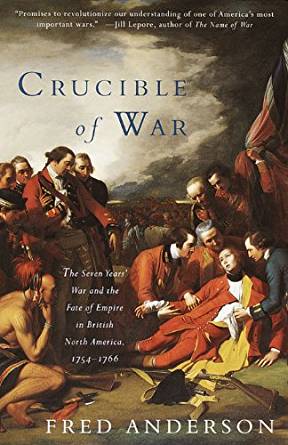
Crucible of War by Fred Anderson

Crucible of War: The Seven Years' War and the Fate of Empire in British North America, 1754-1766 is Fred Anderson’s comprehensive study of the French and Indian War and its aftermath. For those unfamiliar with the conflict, the French and Indian War refers to the war in North America that was part of the larger world conflict known as The Seven Years War.

The conflict pitted Great Britain and her Native American allies against France and her Native American allies. It mostly occurred in lands west of the original thirteen English Colonies as well as in Canada.

Though I found this book interesting and worthwhile for many reasons, my initial reason for reading it was that the French and Indian War had a great influence upon the American Revolution, which broke out about twenty years later. I wanted to read a book on this earlier conflict. I did a little research to decide which book to read on the subject.  There are several respected histories out there. This one had a reputation of being the most comprehensive. Some reviews described it as being too academic. I did not find that to be true. Instead, I thought that this work was very accessible and understandable. With that, this is a long book. My edition was more than 700 pages in length, not including endnotes.  

This book is mostly a political and military history. Those not looking to read a lot of military history might want to avoid this one. Personally, I found this work engrossing. The structure of the book is little unusual. The first two thirds or so is an account of the war itself, with a heavy emphasis on military history. The policies and politics of Great Britain’s government are also covered in some detail.

The final third of the book covers history after the war. It is fairly heavy on analysis and makes a strong point that the French and Indian War led to the American Revolution. I found the combination of these two parts to be a little odd. The mix of a detailed political and military chronicle, with a targeted history attempting to prove a point, seems unconventional. With that, I loved reading about both the history of the war itself and the tie-in to the American Revolution.

The nature of the major fighting that occurred during this conflict is explored in some detail. Most military activity centered around British and French forts located in wilderness areas. Each side assembled small armies that traversed the wilderness in an attempt to reach, besiege and capture the other side’s forts. Native American support was key to each side. The British better managed to cultivate Native American allies, which gave them a major advantage. In the end, however, it was control of the sea that gave Great Britain her final victory as French troops and resupply to North America were eventually cut off.

As mentioned above, Anderson explores many connections between the Seven Years War and the American Revolution. Great Britain ran up an enormous national debt during the Seven Years War. She was still expending large sums on protecting Canada and the other territorial acquisitions that were taken during the war. As a result, Parliament levied taxes on the thirteen colonies to help pay these expenses. These taxes were a major cause of the revolution.

New territories were also taken from France to the west of the thirteen colonies. The colonists were eager to move out and settle those lands. Great Britain, wanting to avoid conflict between the colonists and Native American tribes, attempted to close off these western territories to the colonists. These restrictions caused enormous friction. Anderson’s analysis of this issue contains his take on the philosophy that related to British ideas of Empire and colonialism. I found this line of inquiry intriguing.

 Tensions between British troops and the colonists actually began during the French and Indian War, when British generals demanded that the colonists provide quarters to British troops. Also, British troops and Provincial forces served together. Instead of harmoniously working together, this only added to the friction.


The colonists, having fielded large military forces and expended great resources during the conflict, came out of the war feeling that they had sacrificed and done their part. They felt that they had contributed to the world victory that Great Britain achieved. The British on the other hand, generally had the impression that the colonists were unreliable and hesitant to fight.

For these reasons and others, Great Britain and the American colonists were set on a collision course. Anderson writes,

The Seven Years’ War had reshaped the world in more ways than anyone knew. But the lessons both Britons and Americans derived from the conflict would prove inadequate guides when men on opposite sides of the Atlantic tried to comprehend what those changes meant, and dangerous ones when each tried to understand the actions of the other.”

This book may not be for everyone. As mentioned above, it is heavy with military history. There is an incongruity to its two parts. With that, I loved this work. Both segments were of great interest to me. I found it to be a comprehensive chronicle of the conflict. In addition, Anderson digs deeply into the reasons for the American Revolution. This is a subject that fascinates me. The book’s length provided me with a level of detail that I often look for. Ultimately, for those interested in these subjects, this is an extremely informative and fascinating book.