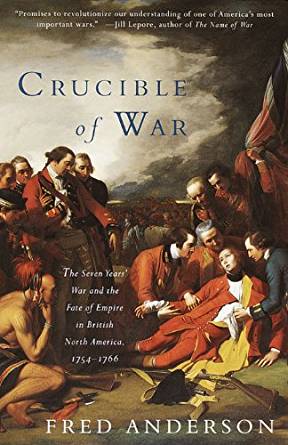
Crucible of War: The Seven Years' War and
the Fate of Empire in British North America, 1754-1766 is Fred Anderson’s
comprehensive study of the French and Indian War and its aftermath. For those
unfamiliar with the conflict, the French and Indian War refers to the war in
North America that was part of the larger world conflict known as The Seven
Years War.
The conflict
pitted Great Britain and her Native American allies against France and her
Native American allies. It mostly occurred in lands west of the original
thirteen English Colonies as well as in Canada.
Though
I found this book interesting and worthwhile for many reasons, my initial reason
for reading it was that the French and Indian War had a great influence upon the
American Revolution, which broke out about twenty years later. I wanted to read
a book on this earlier conflict. I did a little research to decide which book
to read on the subject. There are
several respected histories out there. This one had a reputation of being the
most comprehensive. Some reviews described it as being too academic. I did not
find that to be true. Instead, I thought that this work was very accessible and
understandable. With that, this is a long book. My edition was more than 700
pages in length, not including endnotes.
This
book is mostly a political and military history. Those not looking to read a
lot of military history might want to avoid this one. Personally, I found this
work engrossing. The structure of the book is little unusual. The first two thirds
or so is an account of the war itself, with a heavy emphasis on military
history. The policies and politics of Great Britain’s government are also
covered in some detail.
The
final third of the book covers history after the war. It is fairly heavy on
analysis and makes a strong point that the French and Indian War led to the
American Revolution. I found the combination of these two parts to be a little
odd. The mix of a detailed political and military chronicle, with a targeted
history attempting to prove a point, seems unconventional. With that, I loved
reading about both the history of the war itself and the tie-in to the American
Revolution.
The nature
of the major fighting that occurred during this conflict is explored in some
detail. Most military activity centered around British and French forts located
in wilderness areas. Each side assembled small armies that traversed the
wilderness in an attempt to reach, besiege and capture the other side’s forts.
Native American support was key to each side. The British better managed to
cultivate Native American allies, which gave them a major advantage. In the end,
however, it was control of the sea that gave Great Britain her final victory as
French troops and resupply to North America were eventually cut off.
As
mentioned above, Anderson explores many connections between the Seven Years War
and the American Revolution. Great Britain ran up an enormous national debt
during the Seven Years War. She was still expending large sums on protecting
Canada and the other territorial acquisitions that were taken during the war. As
a result, Parliament levied taxes on the thirteen colonies to help pay these
expenses. These taxes were a major cause of the revolution.
New
territories were also taken from France to the west of the thirteen colonies.
The colonists were eager to move out and settle those lands. Great Britain,
wanting to avoid conflict between the colonists and Native American tribes,
attempted to close off these western territories to the colonists. These
restrictions caused enormous friction. Anderson’s analysis of this issue
contains his take on the philosophy that related to British ideas of Empire and
colonialism. I found this line of inquiry intriguing.
The
colonists, having fielded large military forces and expended great resources
during the conflict, came out of the war feeling that they had sacrificed and
done their part. They felt that they had contributed to the world victory that
Great Britain achieved. The British on the other hand, generally had the
impression that the colonists were unreliable and hesitant to fight.
For
these reasons and others, Great Britain and the American colonists were set on
a collision course. Anderson writes,
“The Seven Years’ War had reshaped the world
in more ways than anyone knew. But the lessons both Britons and Americans
derived from the conflict would prove inadequate guides when men on opposite
sides of the Atlantic tried to comprehend what those changes meant, and
dangerous ones when each tried to understand the actions of the other.”
This
book may not be for everyone. As mentioned above, it is heavy with military
history. There is an incongruity to its two parts. With that, I loved this
work. Both segments were of great interest to me. I found it to be a
comprehensive chronicle of the conflict. In addition, Anderson digs deeply into
the reasons for the American Revolution. This is a subject that fascinates me.
The book’s length provided me with a level of detail that I often look for.
Ultimately, for those interested in these subjects, this is an extremely informative
and fascinating book.

