Pages

Showing posts with label J.K. Rowling. Show all posts

Sunday, May 5, 2019

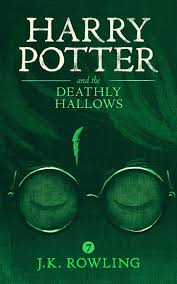
Harry Potter and the Deathly Hollows by J.K. Rowling

Harry Potter and the Deathly Hollows by J.K. Rowling is the seventh and final book in the series.  I found it to be a fitting end to the Harry Potter saga. This entry is an exciting climax to the story. Rowling continues to weave a strong and exciting plot and entertaining characters into some interesting themes. It all wraps up very nicely. 

This book breaks the plot pattern that was established in previous entries. In the earlier books we had the inevitable summer adventures of Harry and his friends, followed by a trip to Hogwarts followed by the day to day occurrences at the magical school. Instead, in the early pages of this book, the evil Lord Voldemort has taken over the Ministry of Magic and most of the power in the wizarding world. Harry and his friends, Hermione and Ron, do not go to back school. Instead, they set off on a quest-like mission to destroy Voldemort’s power by finding and destroying dark magical objects know as Horcruxes. The trio travel the forests and towns of England, encountering friends and enemies along the way, as they fight evil wizards and creatures.

The last fifth of the book involves both Harry and his allies fighting Voldemort and his Death Eaters at Hogwarts itself in a final, spectacular and violent magical battle. The author puts all sorts of interesting elements into the finale. Rowling also shows that she is indeed an author who is a cut above the average fantasy writer.

 A tendency that has been building up throughout the series is that the magical violence and combat is very real and that it involves death, maiming and real brutality.  As mentioned above, Rowling’s attention to detail is impressive.  For instance, even brave characters often experience realistic fear before battle. They are often depicted as trembling. They are often traumatized after magical combat. 

Well established characters die or are physically scarred for life. Ron Weasley’s large family has been close to Harry throughout the books. They all are devastated as one son, Fred, a popular character, is killed in the midst of the Battle of Hogwarts. Other allies, including the married couple Tonks and Lupin, are also killed in the battle. 

At one point, Harry, Hermione and Ron survey the physical and emotional devastation and casualties,

Ron led the way to the Great Hall. Harry stopped in the doorway. The house tables were gone and the room was crowded. The survivors stood in groups, their arms around each other’s necks. The injured were being treated up on the raised platform by Madam Pomfrey and a group of helpers. Firenze was amongst the injured; his flank poured blood and he shook where he lay, unable to stand. 

The dead lay in a row in the middle of the hall. Harry could not see Fred’s body, because his family surrounded him. George was kneeling at his head; Mrs Weasley was lying across Fred’s chest, her body shaking, Mr Weasley stroking her hair while tears cascaded down his cheeks…. 

Harry had a clear view of the bodies lying next to Fred: Remus and Tonks, pale and still and peaceful-looking, apparently asleep beneath the dark, enchanted ceiling. 
The Great Hall seemed to fly away, become smaller, shrink, as Harry reeled backwards from the doorway. He could not draw breath. He could not bear to look at any of the other bodies, to see who else had died for him. He could not bear to join the Weasleys, could not look into their eyes…

He turned away and ran up the marble staircase. Lupin, Tonks ... he yearned not to feel ... he wished he could rip out his heart, his innards, everything that was screaming inside him. 

Rowling has managed to weave together exciting magical battle passages with effective descriptions of the aftermath of violence. Other fantasy writers, such as J.R.R.  Tolkien, have done this before, but Rowling’s technique seems different. I find it effective and believable. 

The character of Severus Snape is also brought to an interesting conclusion here. Throughout the series, the Hogwarts teacher has bullied and even verbally abused Harry. He was known to be a former servant of Voldemort who had switched sides and was allied to Dumbledore in the fight against Voldemort. In the previous book, Harry Potter and The Half Blood Prince, Snape seemed to switch sides again and join Voldemort. In this book it is revealed that he has stayed loyal to the anti-Voldemort cause. His entire story is also revealed to Harry. He had grown up with Harry’s mother Lilly. Years ago, the two attended Hogwarts together. As Snape was drawn to the side of the growing power of Voldemort, Lilly and he became estranged despite the fact that Snape was in love with her. Lilly eventually marries Harry’s father James, who Snape hated. Though Snape tried to prevent it, Voldemort murdered Lilly along with James. At that point, Snape began working with Dumbledore against Voldemort to honor Lilly’s memory. He also pledged to protect Harry as he grew up. Despite the fact that he never waivered in his fight against Dumbledore and that he showed great bravery, Snape stayed an angry bitter bully who still did not like Harry. He still harbored a rancorous resentment aimed at Harry’s deceased father James. All of this adds up to him being a complex character. He was on the side of virtue while being a thoroughly dislikeable person.  His motivation for opposing Voldemort was almost entirely motivated for his love of the deceased Lilly and not inspired by other altruistic reasons. 

I quibble that the book is a little too long. The middle part seems to meander. I think that Rowling could have used a more effective editor.

I would not read this book without reading what has happened before. It does not work as a standalone. This series works best as a whole. 

This book is an excellent conclusion to the series. It ties the plot, character and themes that Rowling had previously developed to great effect. This is a satisfying wrap up of the series. My favorite book of the bunch was the first, this one being my second or third.  In the end, I am glad that I finally gave this series a go. 

Thursday, February 21, 2019

Harry Potter and The Goblet of Fire by J.K. Rowling

Harry Potter and The Goblet of Fire by J.K. Rowling is the fourth book in the series. Like the previous entries, I enjoyed this novel a lot. The plot is interesting. It is full of fun characters, places and situations. Things get darker here and some interesting themes are introduced. 

Harry and his friends, as well as some enemies, are back for a fourth year at Hogwarts. This time, the evil Lord Voldemort is slowly gaining strength and hovering around the edges of the story, threatening Harry. At the same time, the Triwizard Tournament has come to Hogwarts. This is a magical competition between young wizards. Each participant or champion is chosen by a different magical school and represents that school in the competition. Despite the fact that he never intends to enter, Harry is maneuvered by unknown interests into becoming one of the champions from Hogwarts. Harry and the other participants are presented with a series of difficult and dangerous hurdles to overcome. Harry and the other champions are tasked with getting past dragons and dealing some ornery Merpeople as well as engaging with a host of other frightening creatures in their quest for the cup. Things turn a bit ugly when Harry ends up in a fight to the death with Voldemort himself. 

I have commentated that in previous books, the series had settled into a certain routine. This book continues some of the patterns of the last three. The narrative mostly consists of Harry and his friends’ day to day adventures. There is a whole host of entertaining passages to read about characters and creatures thrown in for good measure. Harry and his friends are getting older, so they are starting to become interested in dating. There is ball that diverts the interest of the students of Hogwarts and their guests from other magical schools. On the periphery, as usual, Lord Voldemort is sneaking around and is plotting to do bad things to Harry and the world at large. The magical competition and its mini adventures are similar to the magical encounters from previous books. Despite its familiarity, I found all this fun and interesting to read about. 

Rowling does begin to throw in some new and interesting elements here. The realities of the universe that the author has built begin to present themselves here. This world of Harry Potter consists of a worldwide community of wizards and other magical creatures that exist in parallel to the nonmagical, known as the Muggle, world.  This magical world hides its existence from the nonmagical world through the use of magical means. This world of magic has its own government, educational system, social customs, etc. This society is mostly a free one, it has elections, laws, a system of ethics etc. Throughout the series, we have seen that the society is flawed however. In this book, the flaws become a lot more apparent. We see that people, such as Harry’s Godfather, Sirius Black, are sometimes falsely imprisoned, the authorities sometimes impose death sentences on magical creatures based upon false pretenses, and the government is shown to be sometimes corrupt. 
Furthermore, around the time of Harry’s birth, a savage war raged between the government, which was controlled by the forces of light magic, and Voldemort’s and his dark wizards known as Death Eaters. Sirius Black tells Harry how during the worst of times, when Voldemort was murdering and torturing people and targeting his opponents’ families, many of the wizards on the light side resorted to unethical tactics and compromised their ideals in order to fight Voldemort. This seems an accurate representation of how free societies and individuals sometimes behave when under existential threats such as war. 

Perhaps the worst societal ill depicted involves magical species known as House Elves. These creatures are in a condition of slavery. They are bound to particular families and are controlled through magical means.
Harry’s friend Hermione decides to take up the cause of the House Elves. She comments, 

"You know, house-elves get a very raw deal!" said Hermione indignantly. "It's slavery, that's what it is!... Why doesn't anyone do something about it?" 

Later she observes how the oppression is covered up and that even in a book, Hogwarts, A History, that she admires, the existence of House Elves at the school, is omitted,

"House-elves!" said Hermione, her eyes flashing. "Not once, in over a thousand pages, does Hogwarts, A History mention that we are all colluding in the oppression of a hundred slaves!" 

Hermione decides to do something about it and begins a campaign to free them and provide better living conditions for them.

I think that Rowling is depicting an interesting dynamic here. We see a flawed magical society, that contains some oppressive and harmful institutions, that is threatened by the outside forces of Lord Voldemort, who have no morality and are completely malevolent. 

It seems that Rowling is portraying a magical world with parallels to the real world. Our modern democracies have been, and continue to be, imperfect. There is injustice and oppression in places. Yet, in the past and present, there are malevolent forces that are much worse, that are trying to destroy all of society. I will use a World War II example because it tends to work well.  During World War II, in the United States, there was terrible discrimination and violence aimed at people of color. It was the time of Jim Crowe, the mass lynching of black men and the internment of Japanese Americans, to name just a few of the terrible wrongs. Yet, outside, there was Nazism. Despite everything that was wrong inside of America, there was no moral equivalence between the two systems. I am not saying that there is not injustice and wrongs in modern day democracies, or that there are not malevolent forces lurking on the outside, but the situation that existed during World War II and afterward just makes for a clear-cut example. Many of the same dynamics, in less dramatic form, still exist. 

Hermione, as a friend and ally to Harry Potter, has positioned herself on the side of civilization, against the forces of barbarism as exemplified by Voldemort. Yet, she realizes that within the civilization that she is defending, like our own, there exits terrible injustice. She does not give up and try to overthrow her civilization, but she tries to reform and improve it. She attempts to do so by using peaceful means.  I think that this says a lot about the way our world and history has worked. Existential threats like Nazism and Communism were eventually defeated through the use of force and threats of force. The horrors of Jim Crowe, mass lynching, etc., have ended by people using peaceful, democratic means. There is still a ways to go, but the past offers valuable lessons. Rowling seems to be trying to mirror some of this in her world. 

It may be obvious in what I wrote above that this book takes the turn into darker storytelling than I have talked about in previous posts. References to torture and other nasty things that Voldemort and his allies engage in abound. Voldemort also murders several characters in this novel. Harry begins to show real pain at the loss of loved ones. Though I am sometimes skeptical  of the overabundance of dark fantasy and science fiction that seems to be vogue these days, Rowling does not go too overboard here. Also, the series did need some variation. 


This book continues all the motifs that led to the success of the previous novels. However, Rowling does add these more serious plot points and themes. I find that they add to the story in a positive way. Despite this, the novel is still a lot of fun and I enjoyed it a lot. I will likely continue with the series.