Pages

Showing posts with label The Remembrance of Earth's Past. Show all posts

Friday, June 22, 2018

Cixin Liu’s Death’s End and Gender Issues


This book was translated by Ken Liu. 

The below contains moderate spoilers. Dramatic events happen fairly early on in this book. I reveal some of them.


Cixin Liu’s Death’s End covers a lot of ground both in terms of plot and themes. My general commentary on the book is here.


At one point in the book, Cheng Xin, the story’s main character, wakes from suspended animation several hundred years in the future. She finds that decades of easy living has softened humans. Violence has almost completely disappeared. There is little suffering or struggle. Life is incredibly comfortable for almost everyone. Something strange has happened as a result. Any ideal related to masculinity has disappeared. Femininity in all its forms has become a model to strive for among both men and women. 


Cheng Xin observes the men of the era, 


“[they] had smooth, lovely faces; long hair that draped over their shoulders; slender, soft bodies— as if their bones were made of bananas. Their movements were graceful and gentle, and their voices, carried to her by the breeze, were sweet and tender.… Back in her century, these people would have been considered ultra-feminine.”

Even the majority men of an earlier era who wake from hibernation from earlier times begin to change,

“Most men from the Common Era tried to, consciously or otherwise, feminize their appearance and personality to adjust to the new feminine society.”

There are also signs that the Trisolarans, the alien civilization that is trying to take over the Earth and who are now in constant communication with Earth, are trying to influence Earth’s culture to soften it up. 

The era is a time of strategic standoff between Earth and the Trisolarians. If the aliens attack a very difficult and tough decision will have to be made. If Earth does not retaliate quickly against a Trisolaran strike, humans will be at the mercy of the aliens. However, if Earth does retaliate, it will likely bring the destruction of both civilizations. The parallels between the nuclear standoff that existed between The United States and The Soviet Union are pointed out. 

A person is appointed called the Swordholder. This is the individual who can launch a retaliatory strike in the event of a Trisolarans attack. Luo Ji, from the previous book, has held the position for decades but his retirement is approaching. All the candidates for his replacement are people from the past who have woken from hibernation. People of the current era are deemed incapable of making the difficult decision as retaliation likely means the destruction of both Trisolaris and Earth. 

Cheng Xin, who is a candidate herself, describes the other candidates, who are men, who have woken up from hibernation and who have not taken on feminine characteristics of the time.

“She could see no sunlight in their eyes; their expressions appeared as masks that disguised their true feelings. Cheng Xin felt that she was facing a city wall built from six cold, hard rocks. The wall, roughened and toughened by the passing years, chilled her with its heaviness, and seemed to hint at death and bloodshed.”

Cheng Xin is eventually chosen as The Swordholder. Though she is a sympathetic character, this turns out to be a terrible mistake. When the Trisolarans attack, she does not launch retaliation. It later is revealed that the only reason that the attack occurred, was because Trisolarans had evaluated her personality and determined that it was unlikely that the would launch a counterattack. At one point it is observed, 

“In Cheng Xin’s subconscious, she was a protector, not a destroyer; she was a woman, not a warrior.”

As a result, though they are thwarted before the worst effects of their plan comes to fulfillment, the victorious Trisolarans begin to engage in what will be a nightmarish scenario for humans. 

It turns out that later on, Earth’s counterstrike does get launched. However, it is initiated by an Earth ship whose crew had been in suspended animation and who came from an earlier, pre – feminized era. 

The plot takes place in multiple timeframes, it is interesting that in a later timeframe when life for most humans has become a little harder, most men go back to a more masculine appearance. However, another time period is mentioned when living became comfortable and men began to also feminize.

Later, when humanity has recovered, Cheng Xin makes what be another error, when she averts a war but puts all of humanity in danger. 

Another character, Thomas Wade, is portrayed as ruthless and possibly a sadist. At one point he tries to murder Cheng Xin. However, it is later revealed that based on psychological evaluations he would have been the best candidate for Swordholder. His appointment would have forestalled the Trisolaran attack altogether. Later on, his plans for development of light speed ships is shown to be the best path for humanity’s future. 

With all of the above, Liu has set up a dichotomy in this book between masculine and the feminine traits. 

Poking around Google a bit, it seems that a fairly poplar idea coming from some Chinese commentators and opinion makers that modern men are taking on too many feminine qualities and that this will lead to bad outcomes in the future. I know that this strain of thought is also present in the West also, but it seems more prevalent in China. Obviously, this thinking influenced Liu in this book. 

Liu seems to be saying that an extremely comfortable society, completely free of violence  and suffering will lead to the extinction of masculinity. He tries to show that ultra-femininity will be a draw to people when living conditions become very easy. Even men from more masculine eras are drawn to the feminine ideal. The book portrays this as a natural, but in many ways, undesirable, progression. In the end, a feminized world would be unable to defend itself against external threats. 

More Google searching reveals that some are reading this book and are concluding that Liu is a sexist. I am not sure that this is the case. I think that gender issues are so complicated and that when authors stick their necks out with opinions on it they will inevitably ruffle from feathers. I think that when science fiction authors try to tackle it the results are usually interesting, even when I disagree with what they seem to be saying. 

I think that it makes sense to put masculine and feminine traits in their own buckets. These traits can range from dress and other aspects of physical appearance, mannerisms as well as less superficial traits like aggression and perhaps recklessness. I also think that most men and women display a combination of masculine and famine traits. Most men exhibit more masculine traits, most women exhibit more feminine traits. There are exceptions. Furthermore, while I think that culture can have a big impact on how certain traits are expressed, there is a major genetic component behind many of these traits. Though certain cultural trends might encourage more men to exhibit more feminine traits, I think that biology is too strong for the society that Liu envisions to form. 

Liu depicts the society of The Swordholder as unable to counter the Trisolaran threat because it has become too feminized. My take is that I think that humanity is in a kind of a balance, with most people exhibiting a combination of masculine and feminine traits. I think that if either masculine or feminine attributes were to universally disappear the outcome would be bad in all sorts of ways. Thus, while I think that there is no chance that masculinity will disappear like Liu envisions, the results would be very undesirable it they did. The same can be said however, if feminine traits were to disappear. 

I love it when science fiction authors dig into these issues. The genre of science fiction gives writers a vehicle to go into all sorts of directions on these issues. This is only a small part of what this book is about. Death’s End is filled with all sorts of interesting speculations on this and other issues. Folks who like science fiction and such speculations would do well to read this series. 

Sunday, June 10, 2018

Death's End by Cixin Liu

This book was translated by Ken Liu. 

The below contains moderate spoilers. Dramatic events happen fairly early on in this book. I reveal some of them. 


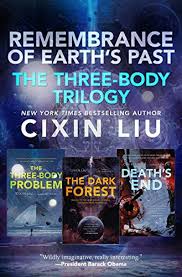
Death’s End is the last book of Cixin Liu’s Remembrance of Earth’s Past Trilogy. Like the first two novels of the series, this is realistic science fiction that covers humankind’s struggle against alien civilizations that wish to either colonize or destroy Earth. The book goes on to touch on humanity’s fate millions of years into the future. At over 600 pages, this work is the longest of the three books, and it novel covers a lot of ground. 

The protagonist of this book is Cheng Xin, a woman who is an aerospace engineer born in what is roughly the present day. We meet Cheng Xi during her university years. A young man, Yun Tianming, falls in love with her. Unfortunately, in the years after graduation, Yun Tianming contracts a terminal form of cancer. Before he succumbs, he volunteers to have his brain sent via a probe to intercept the Trisolaran fleet that is planning to invade Earth. The fleet will take several hundred years to reach our solar system, and human technology is only capable of accelerating something as small and light as a brain on an intercept course. At the same time, Cheng Xin becomes a key figure who helps to shape the future of humanity. Yun Tianming returns later to play major part in the story.

An important plot device in this novel is the fact that Cheng Xin and other characters go into hibernation, or suspended animation, several times over the course of the story. Later, space travel at relativistic speeds mean that a short time can pass for characters on board spaceships while thousands or millions of years pass for the rest of the universe. As a result, the narrative takes place in multiple eras that comprise humanity’s future. Thus, the plot follows Cheng Xin and others during multiple periods in the future. 

So much happens in this book during the various eras. At one point, the Trisolarans destroy Earth’s deterrence system. They gain the upper hand because Cheng Xin is unwilling to launch a counterstrike that will likely destroy both civilizations. Next, The Trisolarans, having only robot probes in the solar system, but also human collaborators, begin a genocidal campaign to cull Earth’s population down to 35 million people through starvation.  Before the worst of the horrors commence, an Earth ship manages to launch a retaliation which is known as “The Dark Forest Signal.” This signal means that the location of Trisolaras, and eventually Earth, is transmitted out to the Galaxy, where malevolent civilizations will likely destroy both civilizations. The Trisolarans evacuate as they try to move their ships as far away from both systems. Humanity is spared, at least until it is destroyed as a result of the transmission. All this is fairly early in the book. Much of the remainder of the story concerns itself with humanity’s attempt to stop or survive the coming strike. 

In a later time period, Cheng Xin wakes up to find that most of humanity has resettled in giant space habitats beyond the orbit of the asteroid belt. This is in anticipation of the destruction of the sun from maleficent alien civilizations, who now probably know Earth’s location. In an even later era, Cheng Xin travels in a starship to other star systems where all sorts of fascinating things are described. At one point, she even encounters Luo Ji, who was the protagonist of the first book. There is also a lot of pathos and sadness experienced by Cheng Xin. Though most of the other characters are not well crafted in this book, I thought that Cheng Xin was captivating, as she showed some nuance, interesting traits, and real emotion. 

There is so much going on in this novel. One of many significant themes is humanity’s and the individual’s insignificance in the face of time. The novel actually opens during the fall of the Byzantine empire. The end of this great civilization underscores the temporary nature of all human endeavors. At several points in the narrative, the fact that high tech, digital electronic recordings have a limited lifespan is emphasized. Later, a mishap with a spaceship traveling at close to the speed of light means that millions of years pass while Cheng Xin experiences only a two-week interval. This means that she will essentially lose people close to her who she loves. So much time has passed that she realizes that an entire civilization might have arisen, died and wiped out on the planet that she is orbiting. She would be able to detect no trace of such a civilization due to the immense passage of time. The enormity of it all hits Cheng Xin,

“She finally understood how she was but a mote of dust in a grand wind, a small leaf drifting over a broad river. She surrendered completely and allowed the wind to pass through her, allowed the sunlight to pierce her soul.”

Later on, Cheng Xin and other characters find some solace and meaning in other ways, but the passage of time is still oppressive. This is just one of the fascinating themes floating around this novel. I am going to devout a separate blog devoted to Liu’s exploration of gender which he also manages to fit in here. The work is filled with many other themes as well as imaginative and speculative science which I found fascinating. 

This book is not self-contained. I would only recommend reading this after reading the first two books of the trilogy. My commentary on the Three Body Problem is here . My commentary on The Dark Forest is here.

While I was reading this book, I thought that this could have been the best book in the series. It was trending that way. It is filled with believable descriptions of wonders, the plot is epic and compelling, and, as per above, I thought that the characterization was stronger than in the previous books.  However, it was marred by an inconclusive ending. After three books, and millions of years, I thought that this work needed a firmer, more solid conclusion. Ironically, the second book, The Dark Forest, had what seemed like a firm and definitive wrap up. 


This book is marvelously inventive science fiction. Liu goes into all different directions here and covers an enormous chunk of time. The story is fascinating. In the end, I thought that the book, especially the ending, was not as focused as The Dark Forest, which I thought was the best of series. With that, this is still very much worth the read for fans of the earlier books. 

Saturday, May 19, 2018

The Dark Forest by Cixin Liu

This book was translated from its original Chinese by Joel Martinsen.

The Dark Forest is Cixin Liu’s sequel to The Three Body Problem and the second book of The  Remembrance of Earth's Past Trilogy. My commentary on the first novel is here.

Taking place in the years following The Three Body Problem, this book concerns itself with the coming alien invasion of Earth. The Trisolaran fleet is 450 years away from reaching the solar system. However, the governments of Earth, working together to deal with the threat, have serious problems. First, The ETO is an organization of humans who are working to assist the aliens. Second, the Trisolarans have managed to send subatomic particles called sophons to Earth ahead of the invasion force. Sophons are basically protons containing supercomputers. They are capable of shutting down all of humanity’s research into particle physics, thus stopping human technological progress at a certain point. This puts a limit on propulsion, weapons and computer technical advancement and means that humans will be unprepared to meet the Trisolaran fleet in the future. The sophons are also capable of spying on humans anywhere, thus allowing the aliens to know everything the humans are doing in their attempts to thwart the invasion.

In response, the governments of the world appoint individuals known as Wallfacers. The Wallfacers are people who are given unprecedented authority to coordinate resistance to the invasion. The Wallfacers work alone and do not communicate their plans to others, as the  sophons can eavesdrop on all communications and conversations. Thus, the Wallfacers plan alone, and they are expected to use subterfuge and work on massive diversions in order to hide their strategies from the Trisolarans.

Luo Ji is the main character in the book and a Wallfacer. Other Wallfacers include: Bill Hines, a former president of the European Union and a brilliant neuroscientst who plans to enhance and manipulate human intelligence to fight the Trisolarans; Frederick Tyler, a former American secretary of defense, who plans to fight the Trisolarans with a fleet of tiny spaceships; Manuel Rey Diaz, the former president of Venezuela, who plans to build massive nuclear weapons that can send planets off of their orbits to use in opposing the aliens.

There are many additional characters, including various members of humanity’s new space fleet. Zhang Beihai is a naval officer who joins the new space fleet and becomes instrumental in its development. Shi Qiang, the rough-around-the-edges detective from The Three Body Problem, is back. He plays a major part as Luo Ji’s protector.


Luo Ji is a fascinating character. Initially, he is chosen as a Wallfacer for inexplicable reasons. He is a mediocre scientist, a womanizer, he is corrupt and hedonistic. He initially tries to refuse the role. When refusal fails, he uses his position to live a life of luxury and excess and does nothing to formulate plans against the Trisolarans. Luo Ji’s behavior is initially taken for a ruse meant to fool the aliens into believing that he is doing nothing while really formulating plans against them. When authorities realize that he is actually just milking the system, they use coercion on him. This prompts him to take action that becomes a true threat to the Trisolarans who, it turns out, have always feared his potential.

As the plot advances, the various plans of the Wallfacers develop along with counter plans of the ETO and the aliens. Later on in the story, many of the main characters go into suspended animation to oversee the plans as they advance over the course of centuries. The depiction of Earth’s future is imaginative and intelligent. Eventually, the humans face a Trisolaran probe that enters the solar system. Everything comes to a head as an enormous fleet of Earth’s spaceships goes to confront it.

This is a serious work of science fiction. Though some of the science seems farfetched, it is mostly based upon real principles. While things like sophons probably could not exist in real life, they are based upon actual theories and at least educated speculation. Future depictions of advances in suspended animation and spaceflight are depicted in scientific literate ways.

There are also references in this book to various science-fiction novels and films, including works by Isaac Asimov and Author C. Clarke. There are references to the writings of Carl Sagan. The plot and themes are also reminiscent of the works of these and other writers. This book, like The Three Body Problem, is a treat for fans of older science fiction as well as those who are interested in science and technology.

There are strong humanistic and positive themes here. As the plot unfolds, it becomes apparent that the universe is filled with advanced civilizations. Due to the need to survive and compete for resources, civilizations are quick to destroy other civilizations in order to eliminate threats and competition. Hence, the “Dark Forest” of the title. The dark nature of the universe is further illustrated when several Earth starships begin a joint, multi-generation journey out into the galaxy in order to escape the alien invasion. Crews of two of the ships murder the crews of the other ships in order to obtain fuel and spare parts. These actions are presented as the only possible way that the ships will be able to reach their destinations. The picture of a very bleak universe and existence is painted here.

However, better tendencies of intelligent life begin to shine through. At one point, a Trisolaran who has attempted to save humanity from destruction speaks to Luo Ji about a future universe that is based upon love as opposed to genocidal survival of the fittest.

“I only wish to discuss with you one possibility: Perhaps seeds of love are present in other places in the universe. We ought to encourage them to sprout and grow.”

Luo Ji replies,

"“That’s a goal worth taking risks for…I have a dream that one day brilliant sunlight will illuminate the dark forest.”

The sun was setting. Now only its tip was exposed beyond the distant mountains, as if the mountaintop was inset with a dazzling gemstone. Like the grass, the child running in the distance was bathed in the golden sunset."

The above seems to encapsulate what are ultimately positive motifs embodied in this novel."

There are also anti-totalitarian themes contained here. As the narrative takes place over centuries, long term trends in human history are fair game for the author.  Both right wing and left wing totalitarian regimes and solutions are shown to be harmful to humanity. Collectivization under strong governments is initially tried on a worldwide basis in order to mobilize human society against the aliens. This leads to catastrophe. Famine and social decay are the result. Eventually, a more open system brings world prosperity and a real chance to oppose the Trisolarans.

I am always hesitant to label a sequel superior to the original. However, as compared to The Three Body Problem, this book has a more interesting plot, more focused themes and more nuanced characters. I think that this novel is better.  With that, it may make more sense to consider The Three Body Problem and this book as one work. The first book ended without a resolution to the alien invasion threat. Though this book is the second in a trilogy, this novel seems to have wrapped up the entire story very neatly. In a way, these two works together make up a single, strong science-fiction story that is worthwhile reading for fans of the genre. This work really does not work as a standalone. It only makes sense as a follow up to The Three Body Problem.

In terms of plot, technology and science, it is a superb book. The characters are interesting and some show complexity. As I mention above, I think that readers of the first book would do well to continue on to this one. I have one more book, Death's End, in the series to go. I am very much looking forward to it.